
- Hosts, Pathogens, and Environment (immediately below)
- Disease cycle
- Types: hardwoods
- Types: conifers
- Acknowledgement
There are a great many, probably thousands, of foliage diseases caused by many different fungi (and a few bacteria and viruses). The diseases are common, but they don’t often seriously affect trees. The ones that have most potential for serious damage are ones that cause premature defoliation. Generally these are not considered economic problems, except with ornamentals, Christmas trees, and in nurseries.
Categories of foliage diseases are loose and not well defined. There are many colorful terms but usually no clear technical meanings. Some foliage pathogens can grow through the petiole into the shoot, or directly infect the shoot, causing a shoot blight or canker.
This might be a good time to review (or view!) concepts of disease, signs and symptoms, and names of diseases and pathogens. If you have a good grip on that, plow ahead!
Hosts

Virtually all tree species can have foliage diseases under the right circumstances.
Pathogens

By far the great majority of foliage diseases are caused by ascomycetes, though in many cases you will see only their asexual fruiting. Some foliage diseases are caused by rust fungi (basidiomycetes), but those are covered separately under rust diseases. Similarly, abiotic diseases affecting foliage are covered separately.
Environment

Foliage pathogens are highly dependent on weather for sporulation, dispersal, and infection. Moisture and suitable temperatures are needed for these processes, and for a few well-studied pathogens (mostly agricultural) the minimum period of leaf wetness and temperature thresholds are known.
Although we sometimes try to link these diseases to especially wet years, keep in mind that weather is critical only during a short time, when the pathogen is exposed during sporulation, dispersal, and infection. If a wet period with suitable temperature occurs at the right time, they can cause a lot of disease even during an otherwise dry year. On the other hand, those pathogens that can produce inoculum and infect whenever conditions are suitable may cause severe disease in wet years or in wet sites than otherwise.
The critical moisture and temperature are in turn affected by stand and site factors. Trees in the understory and lower crowns stay wet and cool for long periods after rain. Foliage also stays wet longer in dense than in open stands. Stands near drainages and on north aspects are often cooler and wetter, which can influence foliage diseases.
Disease Cycle
This is a somewhat typical cycle for foliage diseases. It really applies more to diseases of deciduous trees than evergreens, and doesn’t even apply to all diseases of deciduous trees. However it gives you a starting point to understand other cycles.

Infection courts for foliage diseases
Infection courts vary among the pathogens.
- Direct penetration of cuticle, epidermis (incl. succulent twigs for tip blights)
- Stomates: Some fungi are programmed to follow the contours of the cuticle to find stomates “by feel.”
- Usually not wounds.
Hardwood Foliage Diseases
Anthracnose
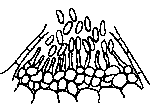
Not uniformly defined, but these diseases tend to have:
- irregular-shaped necrotic areas (often along veins)
- pathogen produces acervuli
- may overwinter in small twig lesions, can cause twig blight when severe
Sycamore Anthracnose
A good example, caused by Apiognomonia veneta on London plane (Platanus Xacerifolia).
- Dormant season: The pathogen causes small twig cankers that may kill buds and twigs. In lesions on fallen leaves, perithecia mature (not usually seen).
- Spring: In twig cankers, the conidial state develops in the form of pycnidia. , perithecia release spores from fallen leaves. Infections of new shoots and leaves. May get shoot blight, rapid death of expanding shoots.
- Spring and summer: Leaf infections, leaf blight. Lesions often occur along midrib (where water accumulates?). Acervuli form in leaf lesions on the underside of the leaves.
Even small lesions can cause defoliation, apparently when near petiole (resistance mechanism?). Small creamy acervuli on underside, cause more infections if weather suitable.


Weather during leaf expansion is critical – wet springs. Sometimes severe, but sycamores keep producing leaves. Conidial state looks different in cankers vs. leaves – shows how fungi defy attempts at classification.
Leafspots
There are many, nondescript leafspot diseases. Many are caused by fungi that form pycnidia. If the spot is sharply delimited, dry and necrotic, it may tend to fall out. Such diseases are often called “shothole.”
Tar spot
Rhytisma spp. A well-known example is Rhytisma acerinum on maples. It is common in northeastern U.S.
Spots begin faintly chlorotic, eventually one or more thickish black stromata develop on the upper surface. Conidia (probably male spermatia) are formed in them during the summer. Leaves fall, then apothecia develop in the stromata during fall and early spring. In May and June, ascospores infect new leaves.
Sooty mold
Sooty mold is not a disease. It looks like black soot on leaves and branches because of dark, superficial mycelium. It usually results from insects, especially aphids and scale insects. The insects need a higher ratio of nitrogen to sugar than the sap provides, so they secrete excess sugars in sweet drops called “honeydew”. Honeydew is the primary substrate for the fungal growth, and the plant is not penetrated. In some cases plant exudates are the substrate.
The fungi are mostly Loculoascomycetes, quite a variety. One common genus is Capnodium. Sooty molds are sually most severe in areas with mild climate.
Sooty mold is common in the Northeast, especially on conifers such as Pinus strobus (eastern white pine), P, sylvestris (Scots pine) and P. mugo (mugo pine). According to Dr. Bill Merrill, cinara and spotted pine aphids, or scales, particularly the pine tortoise scale and the striped pine scale, are common insect associates. Late summer build-up of insect populations leads to blackening of trees in early fall, making Christmas trees unsaleable.
Powdery mildew
So called because they look like a powdery whitish material on the leaf surface. You may need a hand lens to be sure it isn’t dust or residue from bird droppings. These are unusual fungi and diseases for several reasons:

- These are the only fungi we will consider that form cleistothecia. They are an order unto themselves: Erysiphales.
- They are obligate parasites and biotrophs. This means they are very highly adapted for their host. They cannot be cultured on laboratory media. They are apparently tuned into complex organic factors that they get only from their living host.
- Probably as a result, they are usually host-specific. There are powdery mildews on thousands of different angiosperms, and for the most part each one is a different fungus species and will not grow on another host. In crop plants, they are even specific to cultivars: each cultivar has a certain mildew race that can grow on it. This is a very sophisticated interlock with the host!
- Most are entirely superficial, except for the haustoria in the epidermal cells. No hyphae go inside the leaf. They are so delicate in their relation to the host.
- During summer, they produce conidia in chains on short, straight conidiophores. They are airborne, and carry an unusual amount of water with them, so these fungi are less dependent on wet conditions for infection than others. They can actually disperse and infect under humid conditions with no free water!
- There are half a dozen common genera; simple keys to genera can be found in many books. Cleistothecia usually appear in late summer to early fall as the mycelium collapses. They usually overwinter as cleistothecia, which discharge ascospores in spring.
- Sensitive to sulfur, and noticeably absent from areas of high SO2 pollution.
A good example of a powdery mildew is that of flowering pear.
Leaf blisters and other diseases caused by Taphrina spp.
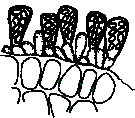
Also obligate parasites. They cause the host to overgrow in infected areas. Lead to blister, puckering, curling, expansion.
This pathogen (or properly, genus of pathogens) is the only one we will deal with naked asci. There is no ascoma; they just have their asci hanging out in the breeze – on the leaf surface. The ascospores keep dividing so the asci have lots more than 8 spores.
Peach leaf curl is an important disease in orchards, caused by Taphrina deformans.
One curious one is on female catkins of alder – what a specific habitat! It causes the bracts to grow much longer than normal so they look like tongues sticking out. Even more curious, there is a powdery mildew that also is restricted to the female catkins of alder. There must be something good happening in those catkins that we don’t know about!
Conifer Foliage Diseases
Foliage diseases on conifers are often more damaging than those on hardwoods, at least under certain conditions. Why?
- Conifers cannot refoliate like hardwoods. A defoliated hardwood will have a full complement of leaves the next year if not the same year.
- Most conifers depend on several years of foliage, so they are severely impacted if they lose some. Growth can come to nearly a complete stop.
However, most either infect foliage of current season or older foliage, not both, so mortality is rare. Under what conditions are they damaging?
- Trees “off site” (wrong type of site for the species) or out of native range
- Pure stands
- Dense stands
- Seedling, sapling, small pole stages, under about 30 years old, often more susceptible
- Christmas tree plantations usually fit all four of these criteria!! For Christmas trees, the problem is doubly severe because appearance (full complement of foliage) is at least as important as good growth.
Let’s address here several generalizations you often hear about diseases from non-pathologists:
- One is that, “it’s not nice to fool with mother nature,” the idea being that diseases are more severe in artificial, managed systems. Well, this generalization seems to hold pretty well. Pure stands, even-aged stands, trees planted where they don’t grow naturally: these often result from human management and can be associated with increased damage from foliage diseases (certainly not always).
- Another generalization is that “diseases are nature’s way of taking out the old and unfit, weak, cleaning up the forest, and making way for the young.” Leaving aside the appeal-to-nature fallacy and that of ascribing purpose to nature, foliage diseases of conifers clearly don’t fit that generalization. Trees are often more susceptible when they are young and in their most vigorous stage. As far as I know, foliage diseases are never involved in the death of overmature trees. Stress and suppression seem to make no difference to some of them. Rhabdocline needle cast of Douglas fir is an example.
Needle casts vs. needle blights
There is confusion about these disease types in some presentations.
- Needle casts have only one infection period per year and per generation. This means that, not only will inoculum be produced only during one period during the year, but an individual will produce inoculum only once during its lifespan, even if it lives in the living needle for multiple years. Some do infect current-year needles, but don’t sporulate until 3-4 years later.
- Needle blights can produce inoculum and secondary infections whenever temperature and moisture are favorable. A single infection can result in new infections throughout the growing season. There may even be multiple generations during the season, so that an infection in spring results in inoculum creating more infections, and those infections do the same, and so on, all during a single year.
Needle casts
This name is obviously used because needles are often lost, or cast, prematurely. However, there are some known (for instance on larch) where the needles are kept longer than normal.
Hosts
Most genera of conifers serve as hosts to needle casts.
Pathogens
Most needle casts are caused by a characteristic group of ascomycetes in the class Leotiomycetes, order Rhytismatales, family Rhytismataceae (same group as the pathogen of tarspot, above!). There are at least 40 pathogenic species in this family in the U.S. These include the genera Bifusella, Cyclaneusma, Davisomycella, Elytroderma, Hemiphacidium, Lirula, Lophodermella, Lophodermium, Meloderma, and Meria.

But some needle casts are caused by fungi in other groups of the Ascomycota. These include Swiss needle cast, caused by Nothophaeocryptopus gäumannii (Dothideomycetes: Capnodiales) and Rhabdocline needle cast, caused by Rhabdocline pseudotsugae (Leotiomycetes: Helotiales). The diseases caused by Rhizosphaera spp. are widely called needle casts, but they produce conidia throughout the growing season and can produce multiple generations per year [1], so are clearly needle blights.
Disease Cycles
As noted above, needle casts have only one infection period per year and per generation. Some have an approximately one-year cycle, fruiting the year after infection. Others may reside in needles two or more years before fruiting.
Needle-cast pathogens in the Rhytismataceae usually have modified apothecia, traditionally called hysterothecia. Hysterothecia typically are elongated and have a covering (clypeus) over the hymenium. The clypeus develops a longitudinal slit in the middle. Special cells at the outer edges of the clypeus absorb water under wet conditions and force the slit open to expose the hymenium. When the weather is dry, they close again. Neat! They function like a biological hinge, opening the clypeus like outside basement doors in old houses, or bomb bay doors (an apt analogy considering they may wreak havoc where they land).
Ascospores are usually long and narrow, which may increase the likelihood of hitting a needle. They have a sticky sheath that helps them stick to needles. Sometimes pycnidia are produced, but we think their spores don’t cause infections. Such spores may act as male fertilizing elements (spermatia) to produce the ascomata.
Most parasitic needle casts infect succulent, young, current-year needles during shoot elongation. Some infect mostly older needles, but they are less serious diseases and verge into the saprobic species.
Symptoms
Symptoms include red to brown discoloration, may turn to gray. Discoloration is often regular, the needle dying and turning color uniformly. In some cases, needles retain short green basal portions; in others, irregular discoloration occurs. Not all needles are affected. The irregular distribution of affected needles within a year may help in distinguishing needle casts from abiotic diseases that affect needles.
From the surface, the hysterothecia may appear in various colors such as black, gray, reddish orange, and creamy white, or it may be nearly invisible. The depth at which the hysterothecium forms (subcuticular to subhypodermal) and the thickness and darkness of the clypeus determine how light or dark it appears.
Most release spores around the time of bud break and infect the current-year needles. They mostly show no symptoms until the following late winter or spring. The hysterothecia may appear during that summer and then the needles fall off, or the hysterothecia may take a second summer to mature.
Needle casts on Christmas trees are routinely controlled with fungicide sprays. Spraying is not feasible in the forest, nor is it usually necessary.
Rhabdocline needle cast
Lophodermium needle casts
Many Lophodermium species occur on conifers, but most are very weak pathogens, colonizing needles as they die, or even endophytes, colonizing but causing no symptoms and fruiting as the needle dies. But a few are significant pathogens. There is an important monograph of the genus that is indispensable in identifying species. It is impossible to find online so I am hosting it here. It is a 16 MB download.
Swiss Needle Cast
A separate page on Swiss needle cast tells the story of a disease that has traditionally been common but not severe in forest conditions, but is now causing an unprecedented epidemic on the coast of Oregon.
Elytroderma Needle Cast
Elytroderma needle cast, caused by Elytroderma deformans, is a unique disease that is widespread in North America but usually not very damaging. It is most common on ponderosa and Jeffrey pines, but can also be found on lodgepole pine and pinon. It infects needles as all of them do, but then grows down into the shoot. Much like many dwarf mistletoes, becomes locally systemic and perennial, growing along with the shoot and entering new branches that are formed. Also like dwarf mistletoes, it causes witches’ brooms. The pathogen forms long, dark hysterothecia on infected needles.
Brown Felt Blight
This is another nifty disease. It is caused by pseudothecial fungi that grow on the foliage under snow in spring. After snowmelt the dead shoots can be found covered by a thick felt of brownish mycelium, often studded with small pseudothecia.
A similar disease, snow blight, is caused by unrelated apothecial fungi, especially Phacidium infestans. It is sometimes damaging in nurseries, attacking foliage under a heavy snowpack. A thin, ephemeral, white mycelium may be found on the soft, dead foliage as the snow melts. Late in the summer, small dark apothecia begin to appear on the undersides of the dead needles.
Brown Spot Needle Blight
Caused by Lecanosticta acicola (formerly known also by the name of its sexual stage, Mycosphaerella dearnessii), it is best known on longleaf pine. Longleaf pine is adapted to ground fires. Its older and even newer leaves can be burned off without ill effect. This is one disease that can be controlled to some degree with fire. A ground fire burns the outer dead needles that provide inoculum.
Red Band Needle Blight
This is an important foliage disease of conifers to know about. A separate page dedicated to this disease (also known as Dothistroma needle blight) is forthcoming.
Acknowledgement
The late Dr. Bill Merrill helped shape my understanding of conifer foliage diseases and helped improve this page.
- 1.Albers M, Albers J, Cummings-Carlson J, Haugen L, Wenner N. 1996. Rhizosphaera Needle Disease of Fir. Pest Alert NA-PR-06-96. USDA Forest Service, Northeastern Area <https://forestpathology.org/pdfs/albers_1996_rhizosphaera_fir_pestalert.pdf>.